Disinformation: who lies to us and why
The spread of false information can impact electoral processes, undermine democratic institutions, fuel social polarization, and harm the economy. But who is behind these campaigns, and what do they gain from them?
Disinformation has become the greatest short-term global risk, according to the World Economic Forum’s 2024 Global Risks Report. The international organization warns that the spread of false information can impact electoral processes, undermine democratic institutions, fuel social polarization, and negatively impact the economy. But who is behind these campaigns, and what do they gain from them?
Instigators and Disseminators of Disinformation
First, it’s essential to distinguish between the different levels of responsibility when it comes to spreading disinformation. “There is a UNESCO study that makes a distinction between instigators and agents [or disseminators] of disinformation. Instigators are those who create or inspire the content, involved in its development, while agents are those who act by replicating, spreading, and giving new dimensions to this false content,” explains Carme Colomina, a journalist and principal researcher specializing in the European Union, disinformation, and global politics at CIDOB (Barcelona Centre for International Affairs).
Among the instigators, we find a range of actors, including all types of governments—not only authoritarian ones—political parties, companies (troll farms, marketing agencies, dark PR or “black” public relations agencies), and other interest groups. The group of disseminators includes the same actors but also adds individual people without media and information literacy skills, or those who, driven by their cognitive biases, believe, validate, and share disinformation. This presents “an increasingly complex landscape, where disinformation is less an individual action and more a coordinated effort,” Colomina asserts.
Public Perception
According to the 2024 Digital News Report, only 33% of people surveyed in Spain say they trust the news, a figure significantly lower than the average across the 47 countries analyzed. In the same report from 2021—shaped inevitably by the Covid-19 pandemic—respondents were asked which sources of disinformation concerned them most. The responses ranked as follows: politicians (29%), ordinary people (16%), activists (15%), journalists (11%), and foreign governments (9%).
Actors Behind Organized Manipulation
Identifying exactly who is behind disinformation campaigns is challenging due to the very nature of these strategies. If people are aware that they are being manipulated, they are logically less likely to be receptive to such messages. However, some studies have succeeded in identifying the origins and funders of organized manipulation. Based on studies published by the Computational Propaganda Research Project at the University of Oxford, these are the main instigators:
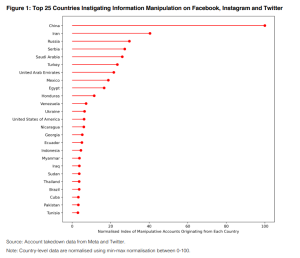
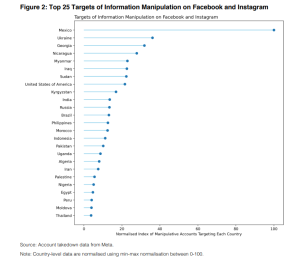
- Government agencies: are increasingly using computational propaganda to shape public opinion. The 2020 Global Inventory of Organized Social Media Manipulation found evidence in sixty-two countries that state actors, including public media, ministries of Communication and Defense, and police forces, have employed computational propaganda to influence public attitudes. China, Iran, and Russia are by far the countries that make the most extensive use of these strategies. Additionally, it has been shown that state actors use these tools to further their geopolitical interests. Among the 25 countries that most frequently engage in disinformation campaigns, 15 are also the primary targets of propaganda efforts from abroad.
- Political Parties: The same study found evidence that political parties in sixty-one countries around the world utilized tools and techniques of computational propaganda as part of their campaigns. Social media has become a critical component of digital campaigns, and some political actors have leveraged the reach and ubiquity of these platforms to disseminate disinformation, discourage political participation, and attack opposition parties.
- Private Companies: A growing trend is the increasing number of private companies involved in computational propaganda. Not only are there companies that disseminate disinformation for their own benefit, but there are also more political communication firms that offer disinformation dissemination as a service. The 2020 Global Inventory of Organized Social Media Manipulation found evidence in forty-eight countries that state actors contracted the services of such companies. These contracts, from 2009 to 2020, are estimated to have reached nearly 60 million dollars. It is important to note that this figure pertains only to confirmed campaigns, so the actual amount could be much higher.
- Influencers and Civil Society Organitzations: An important characteristic of manipulation campaigns is that they often involve the participation of civil society organizations, influencers, or volunteer groups that ideologically support a cause. The report identified the activity of ideological groups in at least twenty-three countries and the involvement of influencers in fifty-one countries.
Why do they lie to us?
There is no single objective behind disinformation, nor is there a single strategy, which makes it even more difficult to combat. “Political parties are the first to have adopted certain strategies, such as fake accounts, for example, to gain traction for their political ideas. Governments have done so as well. We saw this clearly during the pandemic, where many governments used laws aimed at combating disinformation to target, for instance, political dissent or to pursue media plurality,” comments Colomina. “There may even be an interest in economic gain behind certain false information, aligned with a political agenda or a desire to sow chaos,” she adds.
Disinformation is lucrative and is propagated by individuals and organizations with political interests. However, there are also other factors that explain this complex phenomenon. Psychological aspects come into play, such as the role of cognitive biases, particularly confirmation bias, which pushes us to believe what aligns with our pre-existing beliefs. Sociological issues must also be considered. For instance, socially disadvantaged groups show a greater predisposition to believe in conspiracy theories or alternative viewpoints. Furthermore, conspiracy theories and other disinformative narratives provide users with a sense of belonging to a group.
In the words of Filipino journalist and Nobel Peace Prize laureate Maria Ressa, the ultimate goal of disinformation campaigns “is no longer for you to believe in something, but to distrust everything.” She warns: “Without facts, there can be no truth; without truth, there is no trust and no shared reality, which means democracy cannot exist.”