Glossary of Disinformation: Basic Terms You Need to Know
The terms related to disinformation can be confusing: deepfake, fake news, misinformation, bots, fact-checking… Surely many of these have appeared in social media or WhatsApp messages. But… what do they mean? We offer you an essential glossary of terms to understand the vocabulary of disinformation. Below this lines, 15 key words to help you learn how to stay informed:
1. Bots and trolls
Have you ever noticed followers on your social media that you don’t know, and something seems off about them? Followers with strange names or photos, who are followed by few people, or who post suspicious content? These might be bots. Bots are fake followers, social media accounts created automatically, but they don’t belong to any real person. They are often used for propaganda or other purposes. Unlike bots, which are automated accounts, trolls are real users who actively participate in debates, attack those with differing opinions, and intentionally promote false or polarizing narratives. Their goal is to create noise and create doubt on sensitive topics such as elections, public health, or international conflicts, using tactics like sarcasm, provocations, fake news, or mass messaging. Their activities are often coordinated and funded by actors with specific political or economic interests.
2. Deepfake
This is a technical term, but one we need to get familiar with, as it’s predicted that, with the increasing capabilities of artificial intelligence, its use and realism will continue to grow. Deepfakes are fake content generated using artificial intelligence. Through synthesis techniques, for example, two videos can be mixed to create a third that is fake but appears realistic. If you want to test yourself, we recommend whichfaceisreal, a website that invites you to distinguish between two people, which one exists and which one doesn’t. Artificial intelligence can do wonders, for better or worse, and it seems that when the human eye falls short in discovering the truth, another technology—blockchain—could help in the future by certifying the source of information.
3. Disinformation
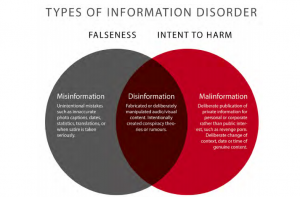
Is it the same as fake news? Does it include jokes and manipulations? What does it mean? Although there is no single definition of disinformation, the most widely accepted one is that proposed by Wardle and Derakhshan (2017), who understand it as a type of information disorder and, more specifically, as “information that is false and was deliberately created to harm a person, a social group, an organization, or a country.” While the most popular and common expression to refer to this phenomenon is fake news, academics, journalistic organizations, and fact-checking organizations prefer the term disinformation.
4. Information Disorder
Information disorder, or information chaos, refers to anything that contributes to “contaminating” our information ecosystem; content that creates confusion, deception, and prevents us from being well-informed. And this is a problem. Information is a right for all, as stated in the Universal Declaration of Human Rights, and is essential for a democratic society.
5. Fact-checking
This is the process of cross-checking information from official sources to determine if it is false or, conversely, true and reliable. The term originated in the 1990s in the United States to describe the process of verifying whether the claims made by political candidates in their TV ads were true. It has since expanded, and now any type of source and content is subject to analysis. Fact-checking is a procedure that all journalists must carry out before publishing information, and fact-checkers do it afterward, meaning after the content has already been distributed. There are organizations formed by media professionals that specialize in verifying both official and unofficial sources—social media and other channels. Some are grouped under the European Fact-checking Standards Network and others under the International Fact-Checking Network.
6. Fake news
Disinformation, infodemic, misinformation, malinformation… So, what do we call fake news? As mentioned, journalists and experts in disinformation don’t like this term for three reasons: first, because the term fake news is an oxymoron—if there is good journalistic practice, no false information becomes news, as journalists must verify, contextualize, and expand on any information they receive. Second, because it oversimplifies and implies that deceptions only come to us in news format, when disinformation is a much more complex phenomenon, covering everything from news articles to AI-generated videos, as well as many other formats and strategies. Lastly, because it confuses the public about the source of the deceptions: it tries to install in the collective imagination that only journalists manipulate, when in reality, a wide range of actors are involved.
7. Infodemic
The World Health Organization (WHO) used this term frequently during the global COVID-19 pandemic in 2020. The English word *infodemic* and its Spanish translation infodemia refer to an excess of information—both true and false—that spreads rapidly over a short period of time, much like viruses do. It is essentially an “information epidemic”, as defined by the Pan American Health Organization. The most serious consequence is that with all this whirlwind of data, it becomes difficult to discern valuable and useful information when we need it.
8. Malinformation
Malinformation is information created with the intention of harming someone. It can be true or false, but the key characteristic is its intent to damage a person’s honor, reputation, or professional career.
Tipos de desinformación
9. Misinformation
Misinformation refers to false information that is spread by individuals who believe it to be true. The key difference between disinformation and misinformation lies in intent. While disinformation refers to intentionally false information, misinformation involves the spreading of falsehoods “unintentionally,” as people who retweet or forward such information fail to recognize or verify it. Misinformation also includes journalistic errors, mistakes from other sources, or satirical articles that are misinterpreted as news.
10. Verification
Just as there are people, tools, and content designed to deceive, there are also those with more noble intentions. In this context, verification involves checking whether information from unofficial sources, such as what circulates on social media, is true or false. Since the 2010 Arab Spring protests, which called for better living conditions and democratic reforms, the need for journalists and citizens to be trained in digital verification has become increasingly apparent.
11. FIMI
FIMI stands for Foreign Information Manipulation and Interference (FIMI) Threats. This term was coined by the European External Action Service (EEAS) to emphasize the foreign origin of some false information, such as Russian or Chinese disinformation, viewing disinformation as an exogenous threat. This concept minimizes or overlooks internal disinformation or the domestic ramifications of global disinformation. The EEAS defines FIMI as “a pattern of behavior, mostly not illegal, that threatens or has the potential to negatively affect political values, processes, and procedures. This activity is manipulative in nature, carried out intentionally and coordinated by state or non-state actors, including their representatives both within and outside their own territory”.
12. Astroturfing
Like disinformation, astroturfing is not a new phenomenon nor is it exclusive to the digital world. It is a manipulation strategy that creates the illusion of popular support for an idea, product, or cause that, in reality, does not exist. Instead of emerging organically from the people, these movements are driven by organizations, companies, or governments seeking to influence public opinion. Astroturfing exacerbates the spread of disinformation and is often used to deceive journalists.
13. Prebunking and Debunking
These are related concepts that refer to the same action of verifying information, but they differ in timing. Prebunking involves taking steps to label, flag, and warn about false information before it becomes widely shared and causes harm. It is a proactive approach to building resilience against disinformation and preventing its spread. In contrast, debunking is the process of refuting false information, but after it has already circulated and spread.
14. Hybrid Threats
This term has become particularly relevant in the study of disinformation as a national security issue. Hybrid threats are actions that originate on social media and online platforms, leading to disruptive actions in the physical world. Two recent examples include the January 6, 2021, storming of the U.S. Capitol by Donald Trump’s supporters, who denied Joe Biden’s electoral victory, and the January 2023 occupation of Brazil’s institutions by supporters of former president Jair Bolsonaro, who also refused to accept Lula da Silva’s victory. According to Jungwirth (2023), these hybrid threats involve a set of strategies, tools, and actions carried out by both state and non-state actors to harm a target without admitting aggression, often aimed at undermining the “values,” governments, countries, and individuals of Europe.
15. MIL
MIL stands for Media and Information Literacy. There is a consensus on promoting MIL as a strategy of resilience against disinformation. MIL draws from the concepts of “educommunication” and “media literacy,” which were studied in the 1990s, but has since expanded to encompass the challenges of today’s society. UNESCO defines it as follows: “Skills that enable individuals to search for, critically evaluate, use, and enrich information and media content appropriately; know the rights of every user on the Internet; understand how to combat hate speech online, misinformation and fake news, and cyberbullying; understand ethical issues related to access to and use of information; and collaborate with the media and information and communication technologies as producers of information and content to promote equality, personal expression, media and information pluralism, intercultural and interreligious dialogue, and peace”.
With this glossary, it will be harder to get lost in the sea of disinformation. If you want to learn more, you can explore the different ways disinformation evolves and also who is behind this manipulative content.