Learn to Check contributes to EFE Verifica project recognised with a Global Fact-Checking Award
The project brings together ten stories of people from Europe, the Americas, Africa and Asia whose lives have been affected by disinformation, conspiracy theories and hate speech. It combines articles, documentary videos, social media content and a six-episode podcast.
Learn to Check contributed to the educational dimension of the initiative, in collaboration with EFE Verifica, by developing and delivering six workshops aimed at vulnerable communities. The sessions focused on identifying disinformation and strengthening critical thinking, bringing verification tools to people who may be particularly exposed to the effects of misleading content.
The Global Fact-Checking Awards jury specifically highlighted the project’s educational dimension, as well as its variety of formats and its ability to show, through a people-centred approach, the impact that disinformation can have on people’s everyday lives.


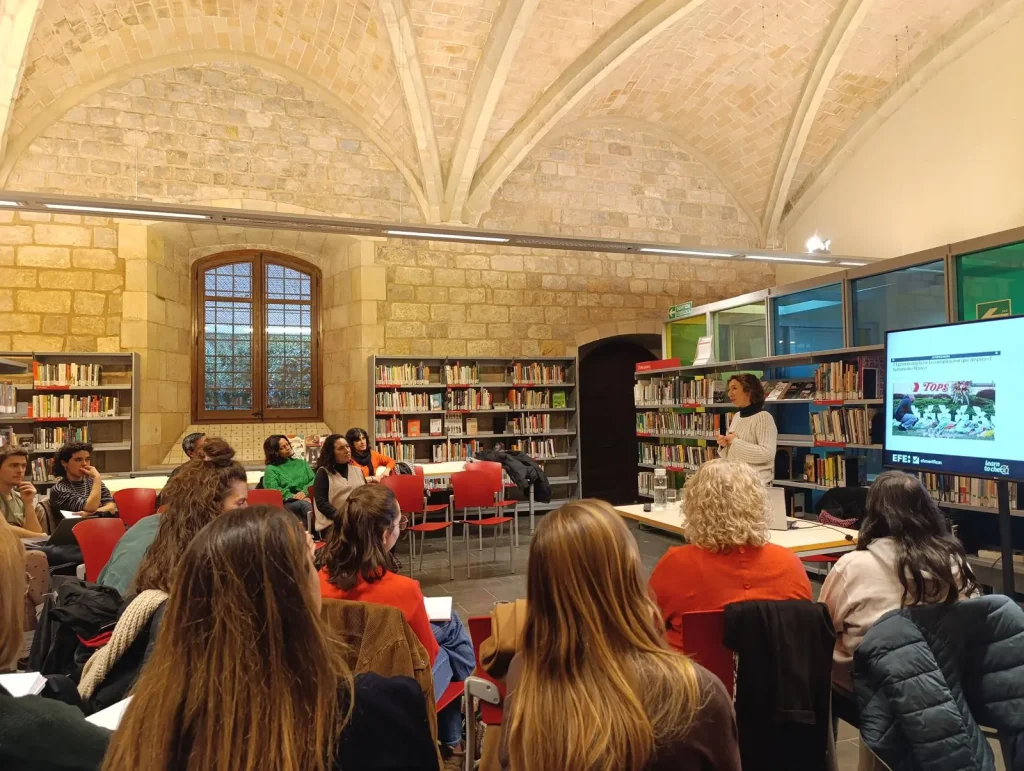


Workshops given in three countries and four languages
Learn to Check delivered workshops addressing different harmful aspects of disinformation to diverse and multicultural audiences. The first took place in the Valencian town of Aldaia, one of the areas hardest hit by the DANA that occurred in October 2024. On that occasion, the training, attended by around twenty people, focused on fake news and hoaxes that circulated on social media in the days following the tragedy. During the workshop, participants watched the report on Verónica Galduf, a resident of Alfafar and the protagonist of the first story in Noticias falsas, víctimas reales, who shared the personal consequences of being a victim of disinformation.
The following session took place at the Santa Pau – Santa Creu Library in Barcelona and brought together 25 participants, who actively engaged in activities designed to understand how hoaxes are created and spread to generate hatred against other religions on social media. During the session, participants watched the report “Asesinado por un rumor”, which explores how disinformation can trigger violence and religious hatred, with irreversible consequences.
Some 150 students of Political Science and International Relations at Royal Holloway, University of London, took part in an online Learn to Check workshop on disinformation and religious hatred. Using the case of Islamophobic violence following the events in Southport as a starting point, students analysed how hoaxes and the manipulation of content can fuel religious hatred.
Learn to Check subsequently trained around twenty Vocational Education and Training students studying Pharmacy at Institut Narcís Xifra i Masmitjà in Girona, who took part in a workshop focused on detecting hoaxes and disinformation related to health and science. During the session, participants watched the report “El vacío de Francisca”, which tells, through the testimony of a woman, the real consequences that prejudice and a lack of reliable information can have. The story recounts how she was subjected to forced sterilisation after giving birth because she was living with HIV in Chile. The report won the 2025 Journalism, Memory and Human Rights Award in Chile in the Best Multimedia Work category.
Finally, Learn to Check delivered two online training sessions attended by around one hundred students, teachers and communication professionals from Brazil. During the workshops, participants analysed how disinformation and hate speech particularly affect vulnerable communities, including the LGTBIQ+ community and refugees. They explored the cases of Jean Wyllys, a former Brazilian congressman who was targeted by smear campaigns because of his sexual orientation, and Zafar Ahmad, an activist who experienced harassment resulting from viral hatred against the Rohingya people.
As a result of these training activities, nearly 300 people in Spain, the United Kingdom and Brazil were reached through workshops delivered in Catalan, Spanish, English and Portuguese.
Other projects to mitigate the damage of disinformation
The Noticias falsas, víctimas reales project is part of a broader range of initiatives that Learn to Check is developing to raise awareness of the harms caused by disinformation and promote fact-checking and critical thinking. These include the Media and Information Literacy Community Connections (MILCC) project, an international initiative to provide media and information literacy training to 150 library professionals in Spain, Ireland and Portugal, and the intergenerational workshop project What I Know About Europe. And You, What Do You Know?, which promotes digital fact-checking, intergenerational dialogue and democratic values.


