Misinformation harms our rights
Misinformation campaigns are coordinated and erode our democratic systems, economies, social coexistence, and even our private lives.
Misinformation harms us individually and collectively much more than we are aware of. Its impact, often unnoticed or underestimated, can affect our voting decisions, consumption choices, health, and financial decisions. Through manipulation and deception, these harmful and coordinated campaigns erode our democratic systems, social coexistence, and even our private lives. Let’s examine the ways in which false information affects our rights:
Right to Privacy
Since the campaigns surrounding the Brexit referendum and the 2016 U.S. presidential election, it has been shown how organized misinformation strategies have exploited our data, which we provide to internet platforms, “to send us micro-targeted information, designed to appeal to our emotions, feelings, or interests,” thereby influencing our decisions, explains misinformation expert Carme Coromina from Cidob.
A paradigmatic example is the so-called “Cambridge Analytica scandal.” In 2018, thanks to the revelations of whistleblower Christopher Wylie, it came to light that this company had been using the data of up to 87 million Facebook users without their consent. They used this data to create psychological profiles with the aim of changing voters’ thinking in a nearly individualized way through both propaganda and misinformation. The consulting firm’s services were used by Donald Trump’s 2016 campaign, and for years, it worked on election campaigns in countries like Argentina, Brazil, Colombia, and Mexico.
Right to Honor, Personal and Family Privacy, and Image
Misinformation campaigns often carry a heavy load of hate speech that can affect the right to honor of individuals and groups, particularly those dedicated to defending the most vulnerable, with the aim of discrediting or silencing them. Examples include attacks against representatives of groups such as immigrants, the LGBTQ+ community—especially targeting transgender individuals—or feminism. The development of artificial intelligence also brings new challenges in detecting fabricated content, particularly images and videos, whose realism has been used not only to deceive, but also to humiliate or violate the right to privacy of both public figures and private individuals, mostly women. Singers like Taylor Swift and Rosalía have seen their faces used to create sexual content. But this technique of creating ultra-realistic images has also been used to humiliate schoolmates, ex-partners, and more. In 2023, several underage girls from Almendralejo reported to the police that dozens of sexually explicit images with their faces, generated by AI, were circulating on social media—a case that was repeated in Mallorca, where three minors were arrested for spreading deepfake sexual content with the faces of their classmates.
Right to Health
The COVID-19 pandemic highlighted the effects that misinformation can have on public health. Rumors, false information, and conspiracy theories spread as quickly as the virus, leading the WHO to warn the international community about the spread of a global “infodemic.” Myths and falsehoods about health didn’t begin with the pandemic, but the speed with which they spread through social media can—and has—resulted in public health issues and the spread of diseases that were thought to be under control. In 2019, the WHO identified misinformation as one of the major threats to health and warned that the resurgence of measles cases in places where the disease was practically eradicated coincided with a drop in vaccination rates linked to inaccurate information about the MMR vaccine (measles, mumps, and rubella).
Social media is also rife with almost miraculous remedies for relieving ailments or diets promising quick results, backed by pseudoscientific claims that create a false sense of credibility. Apart from the financial risk these remedies pose, as they may be created by scammers looking to profit from people’s desperation, they also represent a serious threat to our physical and mental health. These “alternative,” “natural,” “ancestral,” or “detox” solutions can often worsen our illnesses or conditions. In October 2024, the Marbella prosecutor’s office launched an investigation against a company named Immucura, which had been selling illegal cancer treatments to terminally ill patients for a premium price. Another notorious promoter of health-related hoaxes disguised as natural remedies is farmer Josep Pàmies, convicted of fraud for promoting, among other lies, the use of a bleach derivative to “cure autism.”
Right to Uninterfered Democratic Processes
“Misinformation generates chaos, causes distrust, and increases disengagement, ultimately violating the right to a democratic process free from obstacles and hidden interests,” says Coromina. Misinformation campaigns are increasingly used during electoral processes. For instance, in the recent U.S. elections of November 5, 88% of voters for the winning Republican candidate, Donald Trump, expressed concerns about the risk of “electoral fraud” in the polls—an allegation for which no proof has been presented, despite constant questioning of the voting system by the now president-elect.
“In the short term, misinformation seeks to influence electoral results, either harming or benefiting certain candidates. It also attempts to promote abstention,” explains Nereida Carrillo, journalism professor at the UAB and president of Learn to Check. “In the medium and long term, it erodes trust in democratic systems and institutions and undermines democratic values. Without trust, we can’t organize collective actions for societal progress,” she adds. This distrust in the system is further exacerbated by the polarization facilitated by social media. “It’s become so polarized that you’re either with me or against me,” says Carlos Espiritusanto, journalist and professor at the Universidad Carlos III. “This will only create highly polarized societies, even in countries where this never happened, and from there, we will end up with no democracy,” he warns.
The World Economic Forum has identified misinformation as the primary global risk over the next two years, and the fifth global risk over the next ten years in its 2024 Global Risks Report. “Nearly 3 billion people will head to the polls in various economies over the next two years, including the United States, India, the United Kingdom, Mexico, and Indonesia. The presence of misinformation in these electoral processes could severely destabilize the real and perceived legitimacy of newly elected governments, leading to violence, terrorism, and long-term erosion of democratic processes,” the report warns.
Misinformation is also being used in geopolitical struggles for influence to weaken adversaries. International law, in theory, prohibits foreign interference in the internal affairs of another country. However, interference by powerful nations or neighboring countries in national policies is a common practice, often veiled, that has taken unprecedented forms and influence through social media disinformation campaigns. “We could consider that the disruption of certain countries in electoral campaigns of a third country is violating this international legislation,” warns Coromina. There are studied and proven cases. During the 2016 U.S. presidential elections, “it is clearly evident that there were accounts aimed at spreading harmful information about one of the candidates—Hillary Clinton—and in favor of others, and many of these accounts were directly linked to Russian interests,” recalls the expert from Cidob. In the European Union, Russian interference was also confirmed during the Brexit campaign, as well as in the 2017 elections in France and Germany. “In both cases, it is clear how disinformation campaigns had a direct impact on the elections in both countries,” says Coromina.

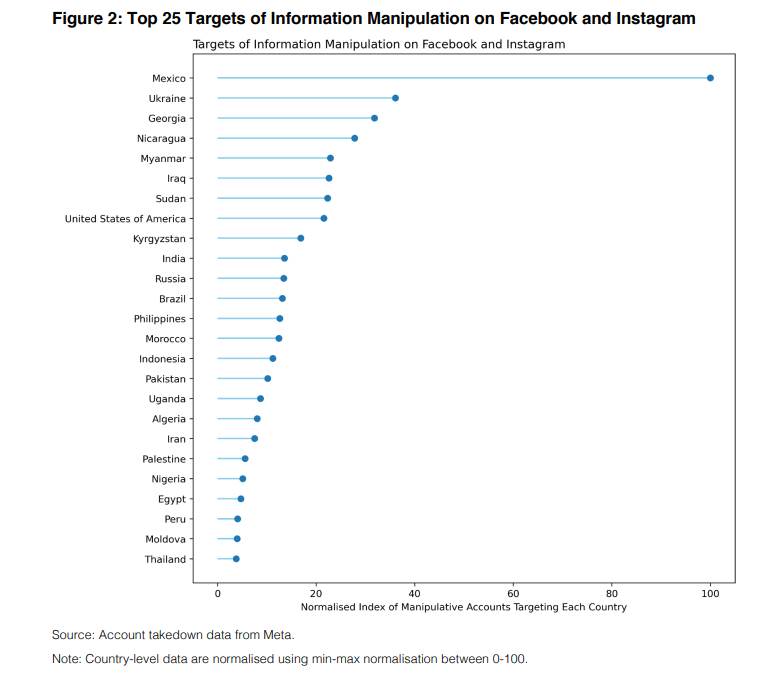
According to 2020 data from the Global Inventory of Organized Social Media Manipulation, the governments of China, Russia, and Iran are the largest users of disinformation campaigns. However, the same report also reveals that disinformation campaigns from abroad are common. In fact, of the 25 countries that make the most use of disinformation, 15 of them are also the main targets of foreign propaganda strategies.
Right to Freedom of Expression and to Receive Accurate Information
Censorship and the loss of freedom of expression are another indirect effect of disinformation, as the strategies of states and supranational institutions to combat it have supported measures to control the content published on the internet, which ultimately affects fundamental freedoms. “Censorship and criminalization are excessively punitive measures that are generally ineffective in combating disinformation and may foster distrust in the authorities,” explains Amnesty International in its report Silencing and Disinformation: Freedom of Expression in Danger During the Covid-19 Pandemic published in 2021.
“Instead of criminalizing and silencing, states should be proactive in providing the population with credible, reliable, objective, evidence-based, and accessible information. Moreover, states should implement comprehensive and coordinated measures to combat the spread of disinformation on the internet, particularly ensuring that social media companies adopt concrete measures to respond to the proliferation of disinformation on their platforms, providing an environment conducive to quality journalism and independent media, and supporting health and internet literacy initiatives,” continues the report.
Children's Rights
“Not having good, verified, and contrasting information that helps me grow is a disservice to the right of children to participate. To be able to participate and be active members of society, they need good information that is not intended to harm them,” explains Nacho Guadix, Head of Education and Children’s Digital Rights at Unicef Spain. A report published in September 2024 by Save the Children on the exposure of Spanish children and adolescents to disinformation and hate speech in the digital environment reveals that Spanish teenagers acknowledge being exposed “to online content that promotes hate and racial and sexual stereotypes.”
Moreover, according to this research, boys are more vulnerable “to discourses that deny gender-based violence and other social movements threatening the patriarchal, racist, and homophobic status quo,” while girls receive aggressive and offensive messages and are more affected “by constant exposure to idealized representations of life and beauty standards,” which negatively impacts their mental health. “In particular, the pressure to conform to desirable body types and objectification leads to low self-esteem and trust issues, which can result in behavioral disorders or self-harm,” the research warns.
Therefore, it is necessary, according to Guadix, to guide minors in their consumption of internet content. Otherwise, they are exposed to risks that range “from consuming inappropriate content to grooming practices, cyberbullying, and online gaming.”


