A thousand ways to lie: kinds of disinformation
False and misleading information constantly evolves and changes its forms and strategies. In this glossary, we present some of its main formats and strategies. You can use this list as a guide to avoid falling into the traps of disinformation.
Disinformation comes in many forms and uses countless strategies to achieve its main objective: to create a climate of confusion so that citizens cannot distinguish what is real from what is fabricated and end up absolutely distrusting everything. A confused society is always more manipulable. This compilation raises awareness and allows for the identification of the main formats and strategies of disinformation:
Satire or parody
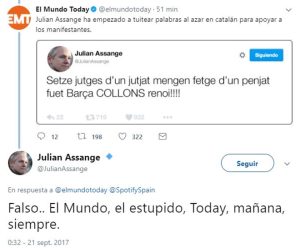
Humor is not disinformation. However, misunderstandings can occur when someone does not recognize a satirical newspaper, a satirical social media account, or fails to identify a meme. For this reason, it is important to correctly assess the source of information. For example, in an exercise that could also be classified as journalistic negligence, in 2020 the newspaper Faro de Vigo gave credibility to phrases that El Mundo Today attributed to Corinna Larsen about the emeritus king, without first verifying whether it was satirical content. Another notable case involved the founder of Wikileaks, Julian Assange, who in 2017 also failed to grasp the humor of the satirical website and believed he was being attacked by the newspaper El Mundo.
Fake context
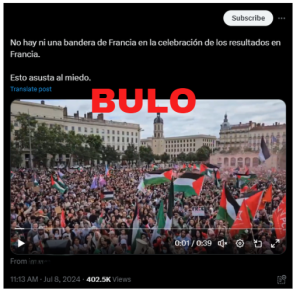
This is one of the most common practices when it comes to manufacturing disinformation. It involves using real information or facts from the past and circulating them as if they had occurred elsewhere or in the present, which completely changes their meaning. This is a common tactic in propaganda wars that accompany armed conflicts, such as in the Russian invasion of Ukraine or the Israel-Gaza war. It also occurs in cultural wars. For example, after the French legislative elections on June 30, in which the left-wing bloc won against the far right, a video circulated on social media showing a crowd waving Palestinian flags, claiming it was a celebration of the election results. This was not true. In reality, these images corresponded to a demonstration in support of the Palestinian people held in Lyon on June 1, nearly a month earlier.
Impostor content
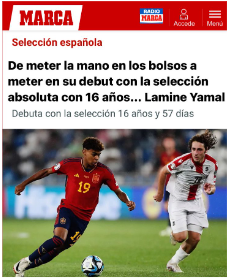
This type of disinformation is primarily based on identity theft. It is characterized by improperly using the name or identity of a legitimate source to lend credibility to false information. For example, when fake websites, social media profiles, or emails are created that appear to come from institutions, media outlets, or public figures, but are actually false. This type of content exploits the trust that people place in real sources to increase its penetration in society. An example could be the network of Russian websites that cloned pages of European media to spread disinformation and propaganda in favor of Russia regarding the war in Ukraine. An investigation published in 2022 revealed that dozens of Russian websites impersonated media outlets from countries such as the United Kingdom, Italy, France, and especially Germany to spread falsehoods in favor of Russia, portraying Ukraine as a failed, corrupt state controlled by Nazis. This cloning campaign was named Doppelganger, which means “ghost brother” in German. But impostor content can be as easy to create as changing the headline of a news article by manipulating an image. This is what happened in September 2023 when a xenophobic headline about Lamine Yamal circulated on social media as if it were from Marca. In reality, the actual headline of the news was: “Lamine Yamal makes history and is now the youngest to play and score with Spain!”
Manipulated content
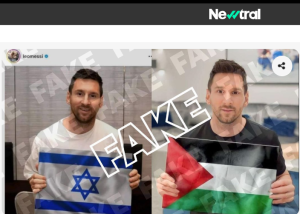
This refers to the alteration of information or images to change their meaning or context. This practice could also be dubbed the Photoshop effect, as it involves retouching the original content, which can be in the form of videos, photos, audios, or text, with the intent of altering its original meaning and serving the lie. It is a type of disinformation that mixes real facts with forgeries, making it harder to detect. A recent example occurred in November 2023, shortly after the outbreak of the war in Israel and Gaza, when photographs of Argentine footballer Lionel Messi circulated on social media showing him with both a Palestinian flag in some images and an Israeli flag in others. Both images had been manipulated. In reality, the originals were part of an advertising campaign in which the player had participated.
Misleading content
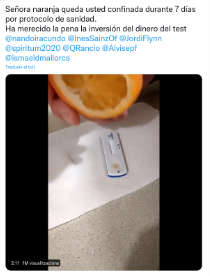
This refers to information that uses real data but presents it in a biased or out-of-context manner, with the aim of confusing the audience. This strategy can be carried out by presenting facts with careless headlines, cropping photographs and videos to show biased perspectives, or by manipulating data. A true statistic can be presented in such a way that it appears to support an incorrect conclusion, or true data can be spurious correlations. This type of content can be more difficult to detect because it often mixes true information with false or decontextualized aspects. For example, during the pandemic, a video went viral showing someone pouring a drop of orange juice onto an antigen test, which subsequently identified it as a positive Covid-19 result. The video was accompanied by text stating that “Mrs. Orange, you would be confined for 7 days,” implying that if an orange could test positive for Covid-19, then it was all a hoax. What was not mentioned in the video is that if the antigen test showed a positive result, it was because the acidity of the orange juice interfered with the detector’s functioning, rendering it useless. Therefore, it was a false positive, but this part of the story had been omitted.
Fabricated content
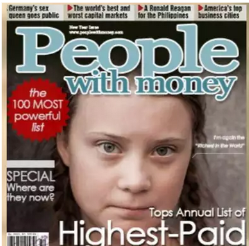
This type of disinformation is completely fabricated, with no connection to reality. Unlike manipulated content, which starts from something real and distorts it, fabricated content is 100% false, although it can appear credible if well-crafted. For example, in 2019, a fake cover circulated claiming that environmental activist Greta Thunberg was one of the highest-paid individuals in the world. The supposed magazine publishing this information was called People with Money, a non-existent outlet. The origin of this disinformation traces back to the website Mediamass, which describes itself as satirical, and according to some fact-checking agencies, it is where the first appearance of the fake cover was detected.
Deepfake
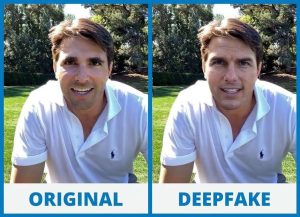
This refers to technology based on artificial intelligence that allows for the creation of videos, images, or audio from real content, in which it appears that a person is saying or doing something they never actually did. Deepfakes are used to create extremely realistic montages, which can result in the dissemination of disinformation or the manipulation of public opinion. There are deepfakes of personalities such as Lola Flores or Luis Aragonés that have been used with consent to develop advertising campaigns, and also in film to create a younger version of Indiana Jones. However, in other cases, deepfakes have also been used to denigrate individuals, as part of campaigns to generate public opinion trends and even to feed into the world of pornography.
Hacking
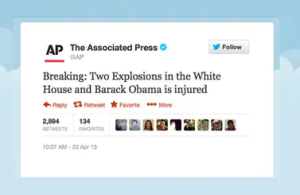
This technique involves unauthorized access to computer systems or personal accounts. Hackers can steal, alter, or misuse information. It can also be used to disseminate disinformation or to impersonate identities and create confusion. In April 2013, hackers supporting the Syrian dictator Bashar al-Assad managed to take control of the Twitter account of the American news agency AP and published a tweet alerting that two explosions had been reported at the White House and that then-President Barack Obama had been injured. The false news caused a temporary plunge in the Wall Street stock market for several minutes.
Fake connection
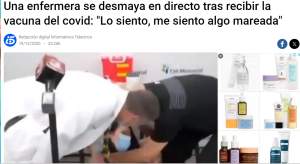
This disinformation strategy occurs when there is an incompatibility between different elements of content, such as headlines, subtitles, images, and the rest of the body of information. During the pandemic, false connections were a common disinformation strategy. For example, Informativos Telecinco published a news article with the headline: “A nurse faints live on air after receiving the Covid vaccine: ‘I’m sorry, I feel a bit dizzy'”. The headline directly linked the Covid vaccine to the fainting episode, but the body of the article explained that fainting is normal and that many people experience it after receiving injections or during blood draws. In a context of information overload like the current one, the practice of false connections is especially dangerous for disinformation, as headlines have ceased to be the first level of reading of content and have often become the only level of reading.
Clickbait
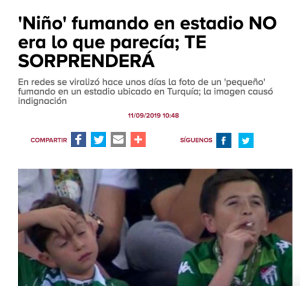
This refers to a type of false connection where eye-catching headlines or images are used to capture users’ attention and get them to click on a link. Although clickbait is not always misinformation, it is often misleading and contrary to the ethical code of journalism, as the headline does not contain the most important elements of the news but rather hides them. The content of the article or link is often of little relevance or quality, and the information typically does not correspond to the promise of the headline. Clickbait exploits human curiosity with the sole aim of gaining audience and can contribute to the spread of sensationalist or false information.
Journalistic mistakes
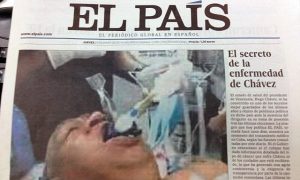
Media outlets are not infallible, and journalists make mistakes when covering news. Although these errors are not intentional, journalistic mistakes can damage the credibility of the media and contribute to misinformation if not properly corrected. An example is what happened to the newspaper El País in 2013 when it published a cover featuring an image of an intubated man, claiming that it was then-President of Venezuela Hugo Chávez, who was gravely ill with cancer in Cuba. It turned out to be an image of another man taken from a video uploaded to YouTube in 2008. The newspaper was forced to withdraw the printed editions, delete the news from its website, and publish a correction.
Hahaganda
This is a form of propaganda that is camouflaged as humor or satire. It is used to promote political, social, or cultural ideas or beliefs, but it does so indirectly through jokes or memes. In this way, it manages to reach a wider audience, and due to the light or fun tone, people do not always realize that they are being influenced. Hahaganda can be a powerful tool because it lowers critical barriers and makes people share content without much reflection.
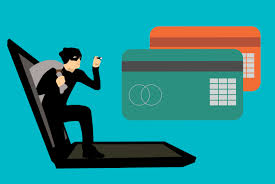
Phishing, smishing and vishing
There are three types of digital scams that aim to steal personal information: Phishing occurs mainly through emails or fake websites that imitate legitimate sites, such as banks or online services, to obtain passwords, credit card numbers, or other sensitive data. Smishing is similar to phishing but occurs through text messages (SMS). The message usually contains a link or requests personal information under a false pretext. Vishing is a scam conducted via phone calls. Scammers pose as legitimate institutions (banks, governments, etc.) to obtain personal or financial information. Elderly individuals, due to a lack of literacy skills, are often the most vulnerable group to these types of scams. If there is any doubt, there are websites like VirusTotal or URLVoid that allow you to scan a link to determine if it may be fraudulent. Other resources, such as Browserling, enable you to run the link externally to see what effect opening the domain might have. By doing so externally, the system remains protected and does not experience malicious effects.
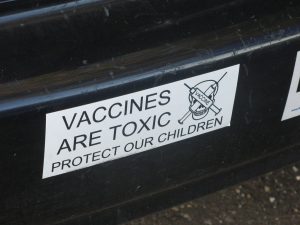
Conspiracy theories
They are beliefs or alternative explanations that suggest a powerful or secret group is behind certain events or situations, usually with malicious intent. Conspiracy theories are often not based on real evidence, but they spread quickly, especially on the internet, because they appeal to emotions and distrust toward institutions.
Diffusion strategies
In the lines above, we have listed the formats of disinformation. However, there are many other forms and strategies. These mechanisms are in constant evolution and try to go unnoticed, but among the most popular is the use of bots (automated accounts) and trolls (real users) on social media. These are organized groups funded by political actors, companies, or entities with specific interests that coordinate the dissemination of disinformation or manipulate conversations online to influence public opinion. There are also commentators who appear in the media or influencers who take advantage of their platform to disseminate all kinds of disinformation, either for profit or ideological conviction. The purchase of media outlets to serve one’s interests is also a common practice. It is known that Russia has deployed a strategy of acquisition or indirect influence over local media in different countries around the world to spread narratives favorable to its interests disguised as legitimate news. In September 2024, the U.S. Department of Justice accused Tenet Media, a far-right political influencer agency, of receiving funding from Moscow to disseminate “propaganda and disinformation.” Kremlin-funded news channels RT and Sputnik have large audiences throughout Latin America and Africa.
Another common strategy is attacks against fact-checkers who focus on identifying disinformation. One of the most recent, directed from Russia, has been the so-called ‘Operation Matryoshka.’ In May 2024, it was revealed that a coordinated strategy had been attempting for months to manipulate the activities of major media outlets and specialized teams in the fight against disinformation with false alerts about deceptions on social media and requests for investigations with the aim of diverting their attention and wasting their time.