Disinformation and migration: main narratives and those responsable
Migrants, refugees or religious minorities are usually one of the groups most affected by disinformation, which calls them criminals (or terrorists), stealing jobs and taking public aid, lack of interest in integrating, anti-Christians… fables that contribute to the rise of xenophobic ideology
Disinformation is not random. Although the volume of false information and the speed of its dissemination may make us think that it is a chaotic and arbitrary phenomenon, the truth is that disinformation campaigns have objectives, strategies and actors behind them. As we have seen with the phenomenon of gender disinformation, minority or marginalized groups are usually one of the preferred objectives of these campaigns. Among them, migrants, refugees or religious minorities are usually one of the most disadvantaged groups. In fact, a recent report from the forum for the social integration of migrants points out that this type of disinformation is on the rise.
Migrants are being stripped of criminals (or terrorists), of stealing jobs and taking public aid, of a lack of interest in integrating into the host societies, of anti-Christians… a mangle of fables, prejudices and racism mixed with deliberately false or decontextualized information that is contributing to the rise of xenophobic ideologies. In this article we will explain some of the characteristics of disinformation about migrants.
How is migration disinformation?
There are two major uninformative issues that revolve around the fear of the immigrant. “On the one hand, we try to show migrants as a threat to the security of the country and, on the other, as an economic threat,” explains Carlos Arcila Calderón, professor at the Department of Sociology and Communication at the University of Salamanca. “One of the most common themes is that of the immigrant as a social burden. That if the “pocket money”, that if they come to take advantage of the public system, that if they do not work and live from the State…”, deepens David Blanco-Herrero, researcher at the University of Amsterdam and member of the Audiovisual Content Observatory (OCA). “Afterwards there is the threat framework (“they come to attack us”) and the link between immigration and terrorism or crime, which is even more common.”. Blanco-Herrero adds a third theme, that of the symbolic charge: “I am not against them, but they are not from here, they are foreigners and therefore I don’t want them to come. This is also closely associated with the foreignisation of Islam. If you are a Muslim you cannot be Spanish, because you do not belong here, the Muslim is not a national.”.
Who's behind?
There are easy-to-identify narratives, such as the posters posted by Vox on the Madrid metro during the 2021 campaign in which it read “One type: 4,700 euros per month. Your grandmother: 426 euros of pension/month”. This information is completely distorted with the intention of generating social rejection by comparing the total cost per place of one of the sheltered minors in the Community of Madrid, including all expenses related to the resource, with the money received by the beneficiaries of widow’s pensions.
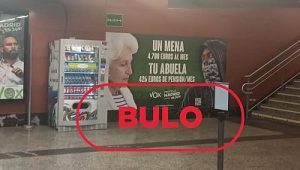
VerificaRTVE
However, often the prime issuer of this disinformation is not so evident. “It is very difficult to know who is the origin of this disinformation, sometimes it can be anyone, from people who have no idea and when this disinformation arrives they can feel indignant, to people with some ends that can go from me everything is the same and what I want is to see the world burn and we will hurt people with a political agenda, or even an economic agenda”, explains Blanco-Herrero. Arcila points out that, although the issuer is not always identifiable, there are agents that take advantage of disinformation against migrants: “Those agents that ideologically are against immigration. See ultra-right parties or ultra-nationalist parties, on the one hand. And on the other hand, we can also find certain lobbies of power that consider that immigration is a problem, not because of an ideology, but because they consider that the control of immigration can improve the stability of societies, especially the most prosperous ones”.
How does media discourse affect?
The coverage made by many media regarding the migratory phenomenon, focusing solely on crisis situations – such as the massive arrival of migrants on the Canary Islands – poverty, marginalisation or violence has paved the way for the proliferation of disinformation. Although the information published in these media may be true, the negative approach and disinterest to report examples of normality, coexistence and opportunities has facilitated the credibility of much misrepresented or false information. “The media coverage -explains Blanco-Herrero- usually deals with topics very similar to those of disinformation. Then, if the recipient is used to listening to this type of news, it already has a basis, a predisposition, to think about immigration as a conflict, which is how it is usually proposed”. “A negative prior interpretation framework is generated that gives space for this type of false or decontextualized information that in turn generates greater stigmatization on immigration,” adds Arcila.
Are there events that trigger the proliferation of disinformation about migrants?
Yes, the agents of disinformation are opportunistic and take advantage of the social concerns that may generate certain events to launch their campaigns of falsehoods. These falsehoods, in turn, help to generate uncertainty and concern and for certain issues to take place on the social agenda. It is the fish that bites its tail. “There are unleashing events, events that have a lot of impact and that make disinformation start to circulate. For example, Spain decides to host a boat with migrants who were totally abandoned in the Mediterranean. Well, here both disinformation and hate speech increase, because these events have a lot of weight in public discourse, at least for a few days,” says Blanco-Herrero.
Do these lies have an impact on the lives of migrants?
The misinformation that runs through the internet has effects on real life and can incite violence and exacerbate social tensions, a phenomenon that is on the rise. According to data from the Spanish Ministry of the Interior, in 2023 the state security forces and bodies investigated a total of 2,268 hate crimes, an increase of 21.3% compared to the previous year, among which, four out of ten were for racism and xenophobia.
There are concrete examples, this summer, in August 2024, when the UK experienced a series of violent riots following the murder of three girls in the town of Southport. Unfounded social media rumors claimed that the attacker was a Muslim asylum seeker, sparking far-right protests and attacks on mosques and migrant shelters in various British cities. It was later revealed that the suspect, Axel Rudakubana, born in Cardiff and of Christian religion, had no ties to Islam. In August 2018, the German city of Chemnitz was the scene of riots following the murder of a German man, allegedly at the hands of asylum seekers from Iraq and Syria. At the time, the authorities noted that the spread of fake news on social networks had fuelled tensions and contributed to the protests becoming violent.

Arcila Calderón points out that there are segments of the migrant population that have a greater risk of suffering discrimination or attacks due to disinformation, the so-called “intersectional audiences”. “It is about audiences where disinformation attacks not only for a reason of discrimination, but for several reasons. I am referring specifically, for example, to migrant women or transmigrant women. That is, where the issue of gender, gender identity and immigration is brought together,” he says.
Disinformation on immigration has a less obvious but clearly quantifiable impact, albeit more indirectly, on public policies. “If disinformation has an impact on public discourse and public discourse, after all, it also determines the political agenda and the vote – Blanco-Herrero reason. If the results of the elections are influenced, if only in a small part, by narratives of disinformation, this also determines public policies and, of course, how they affect people, both immigrant groups and anyone else.”.


